Pythagorean Theorem
Formula, Proof, Examples, and Real-Life Applications
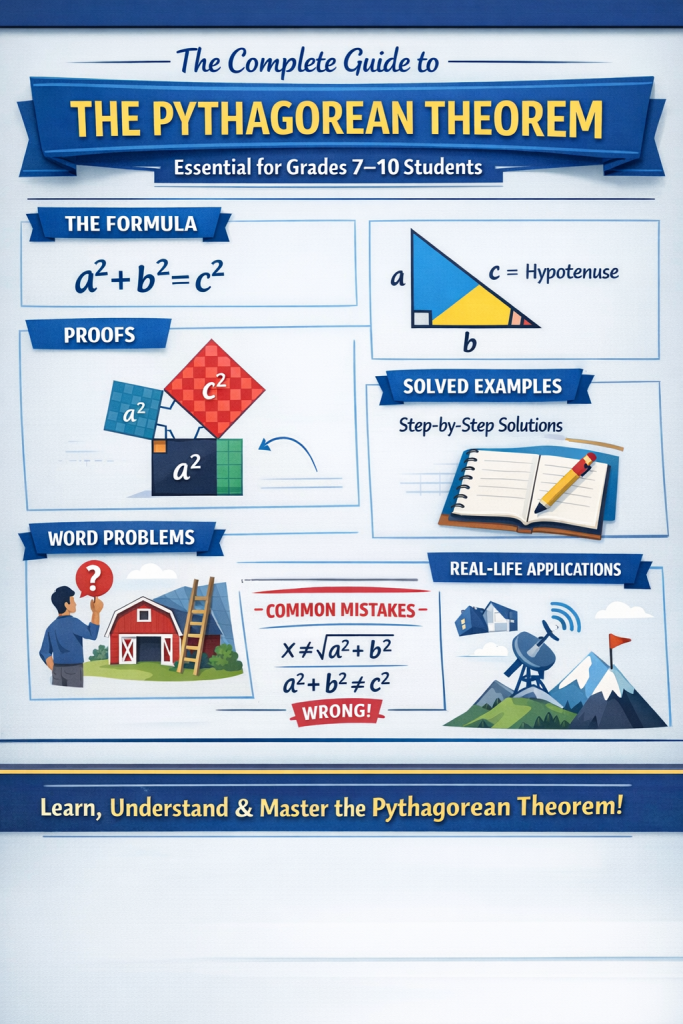
The Pythagorean Theorem is one of the most important and widely used concepts in geometry. It helps us find the missing side of a right triangle and is used in mathematics, construction, engineering, physics, navigation, and even computer graphics.
If you are a Grade 7–10 student or preparing for exams, understanding the Pythagorean Theorem thoroughly is essential. In this complete guide, you will learn the formula, how it works, proofs, step-by-step solved examples, word problems, common mistakes, and real-life applications.
What Is the Pythagorean Theorem?
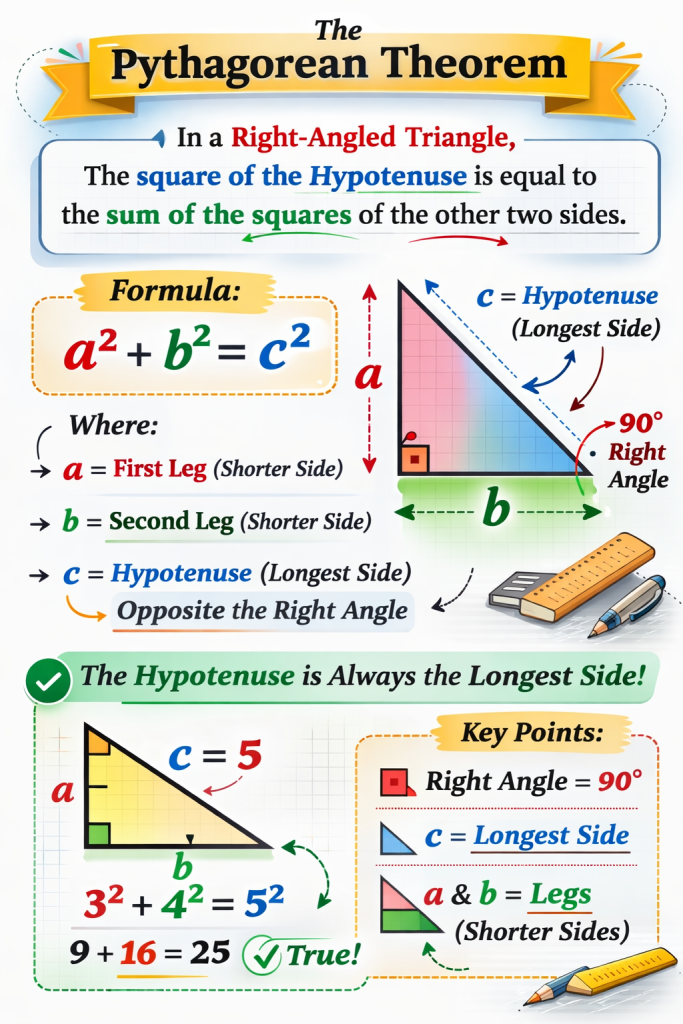
The Pythagorean Theorem states:
In a right-angled triangle, the square of the hypotenuse is equal to the sum of the squares of the other two sides.
Formula:
a² + b² = c²
Where:
- a = first leg (shorter side)
- b = second leg (shorter side)
- c = hypotenuse (longest side, opposite the right angle)
The hypotenuse is always the longest side of a right triangle.
Understanding Right Triangles
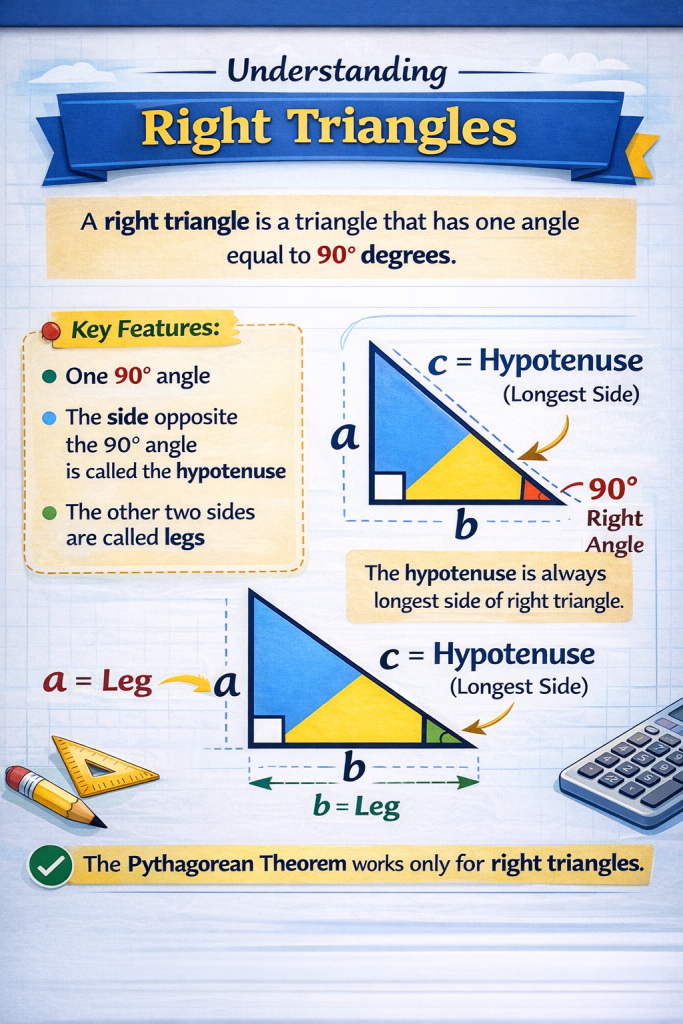
A right triangle is a triangle that has one angle equal to 90 degrees.
Key features:
- One 90° angle
- The side opposite the 90° angle is called the hypotenuse
- The other two sides are called legs
The Pythagorean Theorem works only for right triangles.
Who Discovered the Pythagorean Theorem?
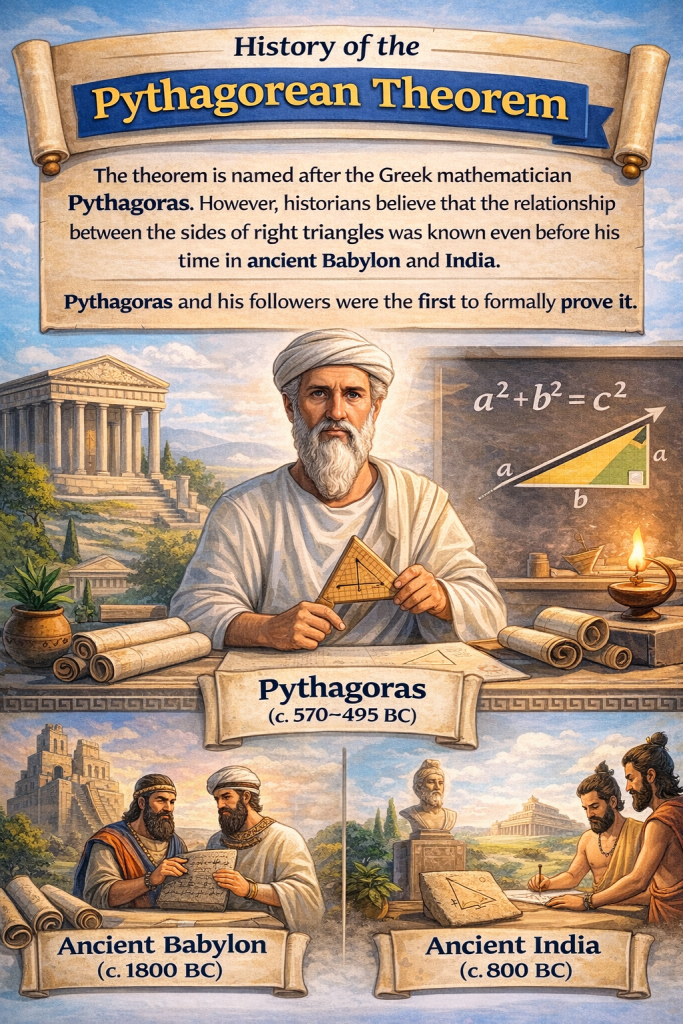
The theorem is named after the Greek mathematician Pythagoras. However, historians believe that the relationship between the sides of right triangles was known even before his time in ancient Babylon and India.
Pythagoras and his followers were the first to formally prove it.
Why Does the Pythagorean Theorem Work?
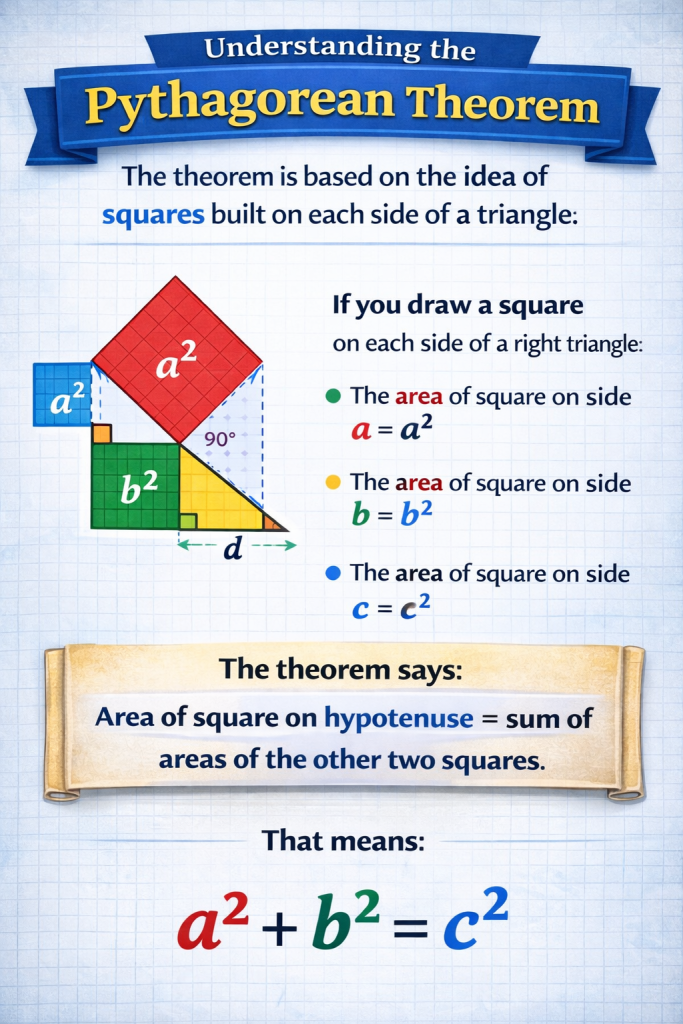
The theorem is based on the idea of squares built on each side of a triangle.
If you draw a square on each side of a right triangle:
- The area of square on side a = a²
- The area of square on side b = b²
- The area of square on side c = c²
The theorem says:
Area of square on hypotenuse = sum of areas of the other two squares.
That means:
a² + b² = c²
Step-by-Step Solved Examples
Example 1: Finding the Hypotenuse
A right triangle has sides:
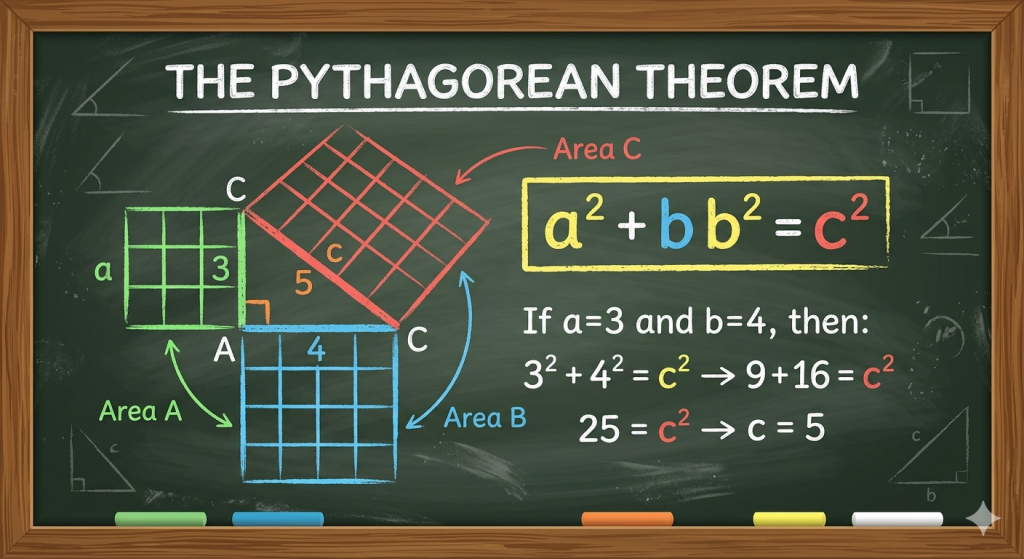
a = 3 cm
b = 4 cm
Find the hypotenuse.
Step 1: Write formula
a² + b² = c²
Step 2: Substitute values
3² + 4² = c²
Step 3: Square numbers
9 + 16 = c²
25 = c²
Step 4: Take square root
c = 5
Answer: The hypotenuse is 5 cm.
Example 2: Finding a Missing Leg
Hypotenuse = 13 cm
One side = 5 cm
Find the other side.
Step 1: Formula
a² + b² = c²
Step 2: Substitute
5² + b² = 13²
25 + b² = 169
Step 3: Subtract
b² = 169 − 25
b² = 144
Step 4: Square root
b = 12
Answer: The missing side is 12 cm.
Pythagorean Triples
Some numbers naturally satisfy the formula.
Common triples:
- 3, 4, 5
- 5, 12, 13
- 8, 15, 17
- 7, 24, 25
These are called Pythagorean triples.
They are useful for quick problem solving.
Word Problems Using Pythagorean Theorem
Word Problem 1
A ladder is leaning against a wall.
The ladder is 10 meters long.
The base of the ladder is 6 meters from the wall.
How high up the wall does the ladder reach?
Solution:
Hypotenuse = 10
Base = 6
6² + h² = 10²
36 + h² = 100
h² = 64
h = 8
Answer: The ladder reaches 8 meters high.
Word Problem 2
A rectangular park is 9 m long and 12 m wide.
Find the length of the diagonal path.
Solution:
9² + 12² = d²
81 + 144 = d²
225 = d²
d = 15
Answer: The diagonal is 15 meters.
Real-Life Applications of the Pythagorean Theorem
The Pythagorean Theorem is used in many real-world situations:
1. Construction
Builders use it to make sure walls are straight and corners are 90 degrees.
2. Architecture
Used to calculate roof lengths and diagonal measurements.
3. Navigation
Helps find shortest distance between two points.
4. Physics
Used to calculate forces and vectors.
5. Computer Graphics
Used in video games and animation to measure distances between points.
How to Check If a Triangle Is a Right Triangle
If you know all three sides:
- Square each side.
- Add the squares of the two smaller sides.
- Check if it equals the square of the largest side.
If yes → It is a right triangle.
Example:
6, 8, 10
6² + 8² = 36 + 64 = 100
10² = 100
So it is a right triangle.
Common Mistakes Students Make
❌ Using the formula on non-right triangles
❌ Forgetting to square numbers
❌ Forgetting to take square root at the end
❌ Mixing up hypotenuse with other sides
Always remember:
The hypotenuse is the longest side.
Practice Questions
Try solving these:
- Find the hypotenuse if sides are 7 and 24.
- Find the missing side if hypotenuse is 25 and one side is 15.
- A ramp is 13 ft long and reaches 5 ft high. How far is the base from the wall?
- Check if 9, 40, 41 is a Pythagorean triple.
(You can create a separate answer section below.)
Pythagorean Theorem Formula Summary
Formula:
a² + b² = c²
Where:
c = hypotenuse
a and b = legs
Works only for right triangles.
Conclusion
The Pythagorean Theorem is one of the most powerful tools in geometry. It allows us to calculate unknown sides of right triangles, solve real-life problems, and understand the relationship between length and distance.
By practicing solved examples, understanding the formula deeply, and applying it to word problems, students can master this concept easily.
If you continue practicing regularly, the Pythagorean Theorem will become one of the easiest and most useful geometry tools in your mathematical journey.